






Realistic polarization model for night sky brightness
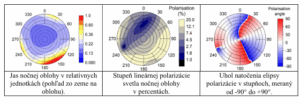
Until recently, light pollution monitoring focused on the directional distribution of light intensity, which became the basis for modeling the penetration of light pollution into the surrounding environment. Polarization measurements were rather rare, because there was a lack of both high-quality instruments and a physical model that would allow for the interpretation of the data. However, polarization opens up completely new dimensions in light pollution research, because it provides previously unavailable information about the light field. We have developed qualitatively new instruments with a high dynamic range and fast response at low illumination levels, which makes it possible to measure the polarization state of the night sky light even in dark locations of national parks, and we have created the first ever model that has passed a difficult test and was able to predict light intensity, degree and angle of polarization in real conditions (see figure below). This is a fundamental advance that will help understand changes in biodiversity, as many nocturnal animals are sensitive to polarized light, and this in turn depends on the type of air pollution and light sources installed in a given location.
Results were published in the journals: Monthly Notices of Royal Astronomical Society and Monthly Notices of Royal Astronomical society: Letters