







Controlling the climate effect of carbonaceous aerosols by modifying their structure
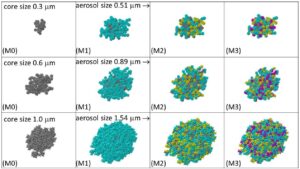 In collaboration with a US partner (Solar Consulting Services), we have demonstrated that aerosol-induced radiative warming can be controlled without the need to reduce carbon emissions. The research was carried out as part of a COST project, where, in addition to harmonizing photometer measurements, we also aim to understand the impact of aerosols on changes in the atmospheric radiation balance. In particular, urban particles originating from industrial activity and transport are a significant source contributing to global warming because they efficiently absorb solar radiation. Our numerical simulations have shown that the radiative properties of particles can be specifically modified by an appropriate combination of materials. The spatial arrangement of materials within the particle volume is key. Our findings have important implications for future regulatory policies. They show that the negative climate impact of carbon emissions can potentially be mitigated even without radically limiting them.
Results were published in Environment International