






Thermoelastic response of multilayer inhomogeneous cylinders: direct integration and single-material approach.
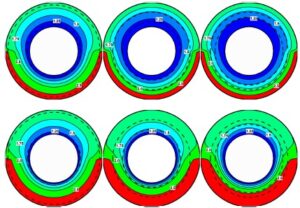
Responses of inhomogeneous composite structures to complex loads, taking into account thermal effects, remain a topical topic due to the wide use of composite materials in various areas. The presence of internal imperfections in the material structure, in particular micro- and mesonohomogeneities, leads to significant disturbances of thermal and mechanical fields, which significantly complicates
their analysis. The classical approach to the analysis of layered structures is based on the investigation of stresses in each layer separately and the subsequent “stitching” of solutions using contact conditions. However, the solution of coupled thermoelastic problems in layered structures is often complicated, and therefore the classical approach is not suitable for the analysis of composites with a large number of layers with arbitrary profiles of inhomogeneity. Therefore, in the works [1, 2] in collaboration with Prof. Y. Tokovy (Ukraine) we proposed a new method for the investigation of fields in thermoelastic layered structures.
The proposed approach is effective in practical implementation for any number of layers, since it interprets a multilayer inhomogeneous structure as a single whole with piecewise-varying properties. This approach leads to the solution of non-classical initial-boundary problems with key equations formulated using generalized derivatives. The developed method allows analyzing the influence of micro- and meso-inhomogeneities (ultrathin layers, contact conditions, micro- and mesodefects) on the macroparameters of the thermomechanical behavior of inhomogeneous cylindrical structural elements. The obtained solutions allow formulating and solving inverse thermoelasticity problems for inhomogeneous bodies in order to determine the optimal profiles of material properties and geometric parameters of layers within the composite.